 Coming to Sprouts · October 2026 →
Caffeine-Free Coffee Alternatives That Give You Energy (Not Jitters)
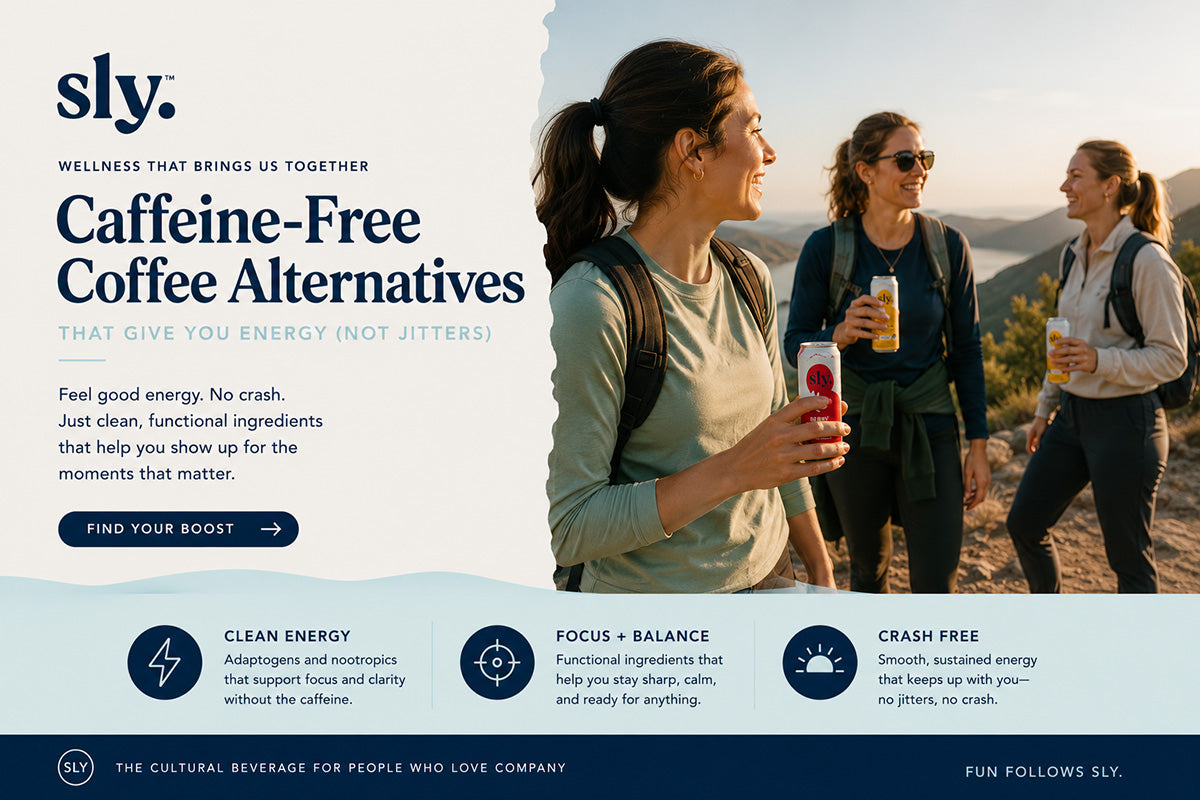
You didn't fall out of love with coffee. You fell out of love with what it does to you at 2:47 in the afternoon. The slump. The second cup that fixes it for an hour, then quietly steals your sleep that night.
We make a caffeine-free drink for a living, and the question we hear most is some version of this: what do I drink instead of coffee that still gets me going? Fair question. Most "coffee alternatives" answer it badly. They either smuggle the caffeine back in or hand you a warm brown cup of nothing. So let's sort the real options from the marketing.
Why People Actually Quit Coffee
The reason is almost never the taste. In our own customer surveys, four complaints come up over and over, and "I hate the flavor" isn't one of them.
- The crash. Caffeine borrows energy from later and charges interest.
- The jitters. Racing heart, shaky hands, that wired-but-tired hum.
- Sleep. Caffeine's half-life runs about five to six hours, so a 3pm cup is still half-active at 9pm. One controlled trial found caffeine taken even six hours before bed cut total sleep by roughly an hour (study). A 2023 meta-analysis put the safe cutoff at 8.8 hours before bed (Sleep Medicine Reviews; Sleep Foundation).
- The stomach. Caffeine relaxes the lower esophageal sphincter, the valve that keeps acid down, which is why reflux drives a lot of people to search for a swap (Healthline).
That last one surprises people. For them, coffee isn't a morning ritual. It's a 4pm regret.
The Trap Hiding in Most Coffee Alternatives
Here's the common failure point. Walk the coffee-alternative aisle and you'll find two camps. Camp one is still caffeinated: matcha, yerba mate, green tea, most "mushroom coffees" (which usually blend mushrooms with actual coffee). You traded one caffeine source for another. Camp two is caffeine-free but inert: chicory root, herbal cups, hot water with ambitions. No jitters. Also no lift.
The thing nobody markets honestly: a drink can be caffeine-free, or it can be energizing, and the lazy ones pick one. We wanted both. That's a formulation problem, not a flavor problem.
| Option | Caffeine | Real energy? | Crash / jitters | The catch |
|---|---|---|---|---|
| Regular coffee | High (~95mg) | Yes, borrowed | Yes | Sleep loss, reflux |
| Decaf | Low (2 to 5mg) | No | No | Same acid hit, zero lift |
| Matcha / green tea | Medium | Yes | Mild | Still caffeine |
| Mushroom coffee | Usually medium | Some | Mild | Often coffee-based |
| Chicory "coffee" | None | No | No | Tastes like coffee, does nothing |
| Caffeine-free functional drink (SLY BOOST) | None | Caffeine-free, formulated for steady energy | No | You have to read the label to trust it |
How a Drink Gives You Energy Without Caffeine
This is where it gets interesting, and where a lot of labels start fibbing. Caffeine works by blocking adenosine, the molecule that signals fatigue. It doesn't create energy. It hides tiredness and bills you later. To get a real lift without it, you back the systems that actually make and aim your energy. Three levers do most of the work in our formula.
B vitamins are cofactors your cells use to turn food into usable energy, the ATP that powers everything you do. That part is settled science (NIH). But here's the catch the supplement aisle won't print: if you aren't deficient, megadosing B12 won't make you bionic. The NIH says exactly that. So we dose for sufficiency, not for a big number that looks good on a panel.
L-theanine, the amino acid in green tea, is the calm half of "calm focus." It pushes your brain toward alpha-wave activity, the relaxed-but-alert state, and trials show it is studied for attention (PubMed; fMRI study). Most studies pair it with caffeine. We keep the theanine and drop the caffeine, which is the unusual move.
Rhodiola rosea is an adaptogen studied for physical and mental fatigue. I'll be straight with you: the research is encouraging but mixed, and some trials have real flaws (systematic review). A couple of solid placebo-controlled trials found it eased stress-related fatigue and supported concentration in studies (RCT). We use it because the downside is low and, in our testing, the upside is real for a lot of people. (We add Alpha-GPC, a choline compound studied for focus, on the same logic. Different lever, same goal.)
Pick Your Swap by the Reason You're Quitting
If your real problem is the 3pm crash, you want steady energy you didn't borrow. If it's the jitters or anxiety, you want zero caffeine, not "less." If it's sleep, the math gets easy: caffeine-free means there's no cutoff to calculate. And if it's your stomach, you want something that isn't acidic and isn't coffee at all.
For all four, the answer lives in the same category. A caffeine-free functional drink, not another mug of brown water.
What We Built, and Why
We got tired of choosing, so SLY BOOST is the caffeine-free version we wished existed. Rhodiola, B vitamins, Alpha-GPC, and L-theanine, cold and drinkable in a can. Two grams of sugar or less. Ten calories. The full list sits on the front in plain English, because "proprietary blend" is usually where a brand hides a weak dose. Focus and balance, no crash to schedule your day around, no 9pm tax on your sleep.
Caffeine doesn't make energy. It postpones fatigue and adds interest. A coffee alternative either swaps in different caffeine (and keeps the problems) or skips it and feeds your energy directly. Want a lift without the crash, the shakes, the 1am ceiling-stare, or the heartburn? Pick one that's caffeine-free and actually built for energy. Then read the label. If it won't show you the doses, it's hiding them.
-
Posted in
BOOST, caffeine-free, coffee alternatives, energy, nootropics



)